The Flint Water Crisis has gained widespread, national attention – and for good reason. Those charged with ensuring this community had safe water utterly failed to do their job. The consequences of this negligence will be felt for an entire generation, and perhaps, beyond. I’ve been sick reading about this story.
For those of you who don’t know, the water crisis in Flint resulted from lead, a dangerous neurotoxin, leaching into drinking water after officials failed to properly treat the water with anti-corrosive chemicals. Evidence of dangerously-high lead concentrations in Flint’s drinking water was known to government officials over a year ago. Yet, no one bothered to fix the problem or notify the residents of Flint that anything was wrong. You know, until the whole fiasco blew up in the national media.
The U.S. EPA considers lead levels over 15 parts per billion (ppb) to be unsafe. Many public health experts claim that there is no safe amount of lead exposure. In Flint, the average water sample showed 27 ppb. Some samples showed lead concentrations as high as 158 ppb. This is what the people of Flint were drinking – unknowingly – for the better part of a year.
Lead poisoning causes permanent damage, and estimates show that as many as 9,000 children in Flint were exposed. An entire city of children has been poisoned, and we have to confront that ugly truth head on.
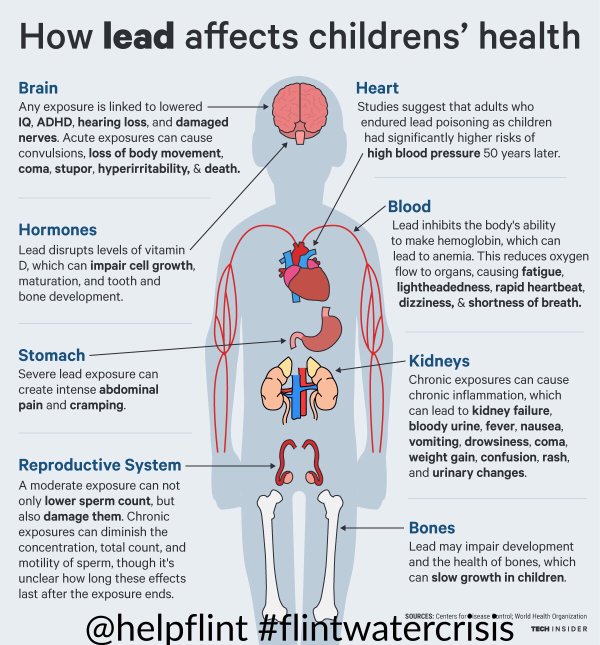
The effects listed above are devastating at an individual level. But at a cumulative, social level, the ramifications are even more serious. The Flint school system will have to adjust to accommodate a large number of children with learning disabilities and behavioral issues.
A growing body of research has also shown clear links between lead poisoning and crime. A study out of the University of Cincinnati followed 300 people from early childhood into adulthood. Those exposed to lead struggled more in school and were more likely to commit violent crime in their teens than their healthy counterparts. The cycle of poverty and crime is a very difficult one to break without the added disadvantage of lead poisoning. The impact this kind of exposure has had on children in the most impoverished parts of our society is only starting to be fully understood.
While the Flint Water Crisis is certainly a worst case scenario, it is by no means the only place in the U.S. dealing with this problem.
Last week, I visited Sebring, Ohio to talk to citizens about recent reports of lead contamination in the village’s drinking water. Sebring is a very small town in northeast, Ohio. I grew up in a town just like it. Believe me, it’s about as quintessential small town Ohio as it gets.
Sebring was in the national spotlight after reports surfaced that, like Flint, citizens there weren’t notified for many months after initial water tests showed lead contamination. I talked to one man who was irate because he only learned about the lead advisories after his child’s school closed. And the problem doesn’t stop in Sebring. A news article in the Columbus Dispatch today documented that of 14 recent lead advisories in Ohio, 10 failed to properly inform citizens.
This scares me. Too many people have been left in the dark, and we’re still coming to learn just how widespread this issue is. Lead is often thought of as “that thing we fixed a long time ago.” The Flint and Sebring Water Crises are highlighting what environmental justice advocates have long known: lead is still here and it’s still wreaking havoc in lives of those least equipped to deal with it.
Lead exposure comes in a lot of different forms, and much of it doesn’t involve drinking water. But, as we’ve seen in Flint and Sebring, all it takes is a few negligent government employees and the wrong mix of chemicals to deliver lead right to our tap. We can and must do better.
These communities need immediate help. The Flint Water Response Team is doing great on-the-ground work and has resources for residents in Flint as well as those of you looking to donate. I’ve yet to find a good source accepting donations for Sebring. After being there it’s clear the town could use help. Let me know in the comments if you know how we can get involved!
 A River on Fire